Our Best Intel: Sports Leagues
|
|
|
Morning Consult captures the leading indicators of consumer intent every day, across global markets, and delivers them through always-on intelligence and custom research built for speed, confidence, and growth. Leaders from the world's largest companies, equity research firms, hedge funds, and the Federal Reserve rely on our 30,000 daily survey interviews in 100+ countries covering more than 5,000 brands, economic indicators, and risk metrics. See the research in action. This week's briefings cover sports leagues. |
|
|
BOTTOM LINE UP FRONT: American sports leagues compete less for new audiences than for share of a finite, distracted attention budget — and the structural advantage is not innovation, but presence across the everyday occasions when sports get watched. The NFL has built an unrivaled mental moat: it surfaces first on nearly all major engagement triggers and carries an emotional connection score roughly 0.4 points higher than the next league. NBA and MLB compete in a clear second tier where the prize isn’t displacing the NFL, but capturing the large lapsed segment — the 46% of aware NFL consumers who haven’t engaged in three months or longer. Ticket and stadium-cost friction is the category’s dominant barrier, and the leagues that solve for occasion breadth and affordability — not those chasing incremental cultural moments — will compound their position. In this briefing, we use the Category Advantage research framework. A few terms you should know: |
- Mental Market Share (MMS) measures a brand’s "mental availability"—how often it comes to mind, compared to competitors, when consumers think of buying in a category
- Category Entry Points (CEPs) are the specific needs, motivations, situations, or feelings that trigger a consumer to consider a product category and the brands within it
- Network Size refers to the average number of distinct usage occasions or buying situations that consumers mentally associate with a brand
|
| |
One league has built a mental moat the others cannot easily breach. NFL holds 25.0% Mental Market Share — twice the NBA’s 12.5% and nearly two-and-a-half times MLB’s 10.6%. More telling is Mental Penetration: 91% of NFL-aware consumers associate the brand with at least one Category Entry Point, vs. 71% of NBA-aware and 75% of MLB-aware consumers. It surfaces first on watching playoffs (72%), holiday-weekend viewing (68%), big-game-everyone’s-talking-about (67%), and rivalry games (64%). When Americans imagine “the moment sports happen,” they default to football. NBA and MLB are not in the same fight as each other. Both have strong daily-cadence engagement — MLB at 58% past-month among aware consumers, NBA at 55%, both flattered by the in-season survey window vs. NFL’s off-season 34%. NBA’s emotional connection (4.16/7) skews narrow: strong with Black and Asian Americans, Millennial men, and urban audiences, materially weaker with women and older consumers. MLB plays a different game: generally second to NFL and ahead of NBA on attendance, hometown identity, and family rituals — and the gap to NFL on attendance CEPs is the narrowest in the data (5–8 points vs. 20+ on most other CEPs). Baseball remains the local-team, in-stadium, generational-handoff sport. Aware does not mean active. 46% of NFL-aware consumers haven’t engaged in three months or longer; for NBA the lapsed-or-never share is 36%, for MLB 30%. NFL’s awareness is so wide that even modest reactivation of its lapsed-but-aware base would dwarf any new-awareness campaign by an order of magnitude. NBA and MLB’s growth, by contrast, will come from deepening frequency, not from waking up dormants. A latent-demand signal beneath the top three. Olympic Games (4.6% MMS), NHL (4.6%), and NCAA Men’s Football (5.0%) cluster as specialists without the breadth to threaten the top tier. More interesting are the soccer leagues: UEFA Champions League and La Liga show Mental Penetration of 47–57%, and Liga MX 42% — all far outpacing 12–17% awareness levels. Among those who know them, they’re surprisingly evocative — distribution and visibility are the constraint, not the proposition. |
|
|
Access the 20+ brand-specific memos about sports leagues |
This week's briefings cover sports leagues at the category level. In addition to these category insights, our team has assembled 20 brand-specific memos — including leagues such as the NBA, NFL, MLB and more. If you're interested in learning more about this data or would like a briefing on a specific brand, get in touch. |
|
|
The top engagement triggers in sports are communal, time-anchored, and ritualistic — not innovation occasions. “Watching playoff or championship games” (~36%) is the #1 trigger. NFL converts it at 72% mental ownership — when Americans think about championship drama, football comes first. “Following my favorite team during the season” (~34%) is the loyalty trigger. MLB’s 162-game calendar and city-by-city tribalism make this its most defensible position — MLB closes within 22 points of NFL here (42.3% vs. 64.5%), the tightest gap on any major CEP. “Watching sports while eating or drinking at home” (~31.5%) and “during holidays or long weekends” (~31%) reward whoever owns the calendar real estate. NFL’s grip on Sunday afternoons, Thanksgiving, and Christmas Day is the single hardest asset to dislodge in American media. “Supporting my hometown or local team” (~29%) is the place-based identity trigger. MLB’s 37% mental ownership here actually beats NBA’s 34% — an advantage local-market sponsors and regional sports networks should be building around. Two secondary triggers reward investment. Fantasy and sports betting (~11%) is concentrated — 21% of Millennial men cite it, and NFL captures 33% of its mental ownership. Betting is becoming the engagement on-ramp for younger men. Social-media-driven discovery (~11%) is the largest Gen Z over-index (17%, +5.9pp vs Total) and the most underleveraged growth lever in the category. |
|
|
What’s Blocking Conversion |
The category’s barriers are not awareness barriers — they are access and affordability barriers. Mental availability is already in place; conversion is being suppressed. Cost friction dominates. Ticket prices are the #1 barrier (43%), with stadium/concession costs (27%) and transportation/parking (22%) compounding it. Among 65+ adults — the demographic with the highest NFL mental ownership — ticket-price friction hits 59%, pricing out the lifelong-fan generation. Among Gen Z it falls to 27%, but only because they don’t expect to attend. The lever is segment-specific affordability packaging — family bundles, accessible upper-deck options, off-peak ticketing — that protects the access pathway without cannibalizing premium revenue. Distribution friction is structural. 20% can’t find games on the services they use, 18% feel too many subscriptions are needed, 16% face local blackouts. The 65+ segment hits 29% on “games not available” — the highest-mental-ownership demographic increasingly locked out by streaming fragmentation. Every league has leverage here through media-rights negotiation. Discoverability hurts younger viewers. 18% of Gen Z says it’s difficult to track where and when games are streaming, and Millennial men over-index on “highlights difficult to access” (+8.6pp). Younger consumers don’t lack interest — they lack a clear path from interest to viewing. Live-event access is geographically uneven. Rural consumers cite “live events are too far” 9 points above the category average. For MLB specifically — where the in-stadium experience is its most differentiated asset — this is a structural ceiling on growth, and a clear case for minor-league brand integration, regional touring, and broadcast investments that substitute for physical proximity. |
|
|
Featured: 2026 Wellness and Fitness Trends Report |
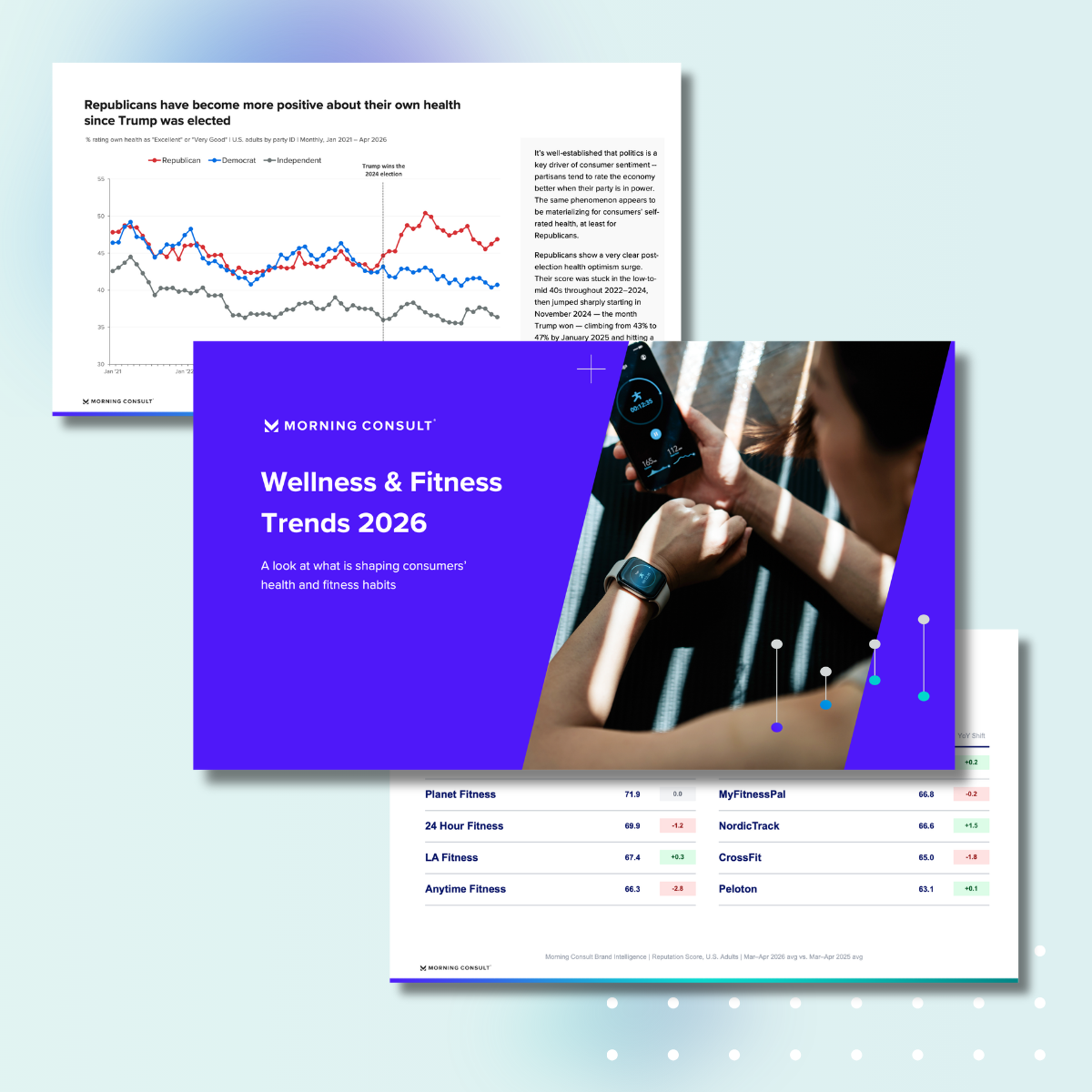
This report tracks wellness behavior, maps self-rated health trends by generation and party from 2021 through 2026, and benchmarks brand reputation across every major category in the fitness and wellness space. |
|
|
Diagnose before spending. For NFL, the gap between 91% Mental Penetration and 34% past-month engagement is the largest reactivation opportunity in U.S. media. Every dollar spent expanding NFL awareness underperforms; the lever is conversion — distribution, scheduling, ticketing, fantasy/betting on-ramps. Defend the calendar; claim adjacent windows. NFL’s hold on Sundays, Thanksgiving, and Christmas Day is unmatched. NBA and MLB should be aggressive about adjacent calendar moments — opening day, All-Star weekends, holiday playoff windows — before those slots saturate. Cultural calendar real estate is finite; whoever owns it sets the terms. Solve the women’s-sports CEP gap. WNBA leads mental ownership of “supporting women’s sports teams” (40% raw association) but the CEP itself is small at 9.9% category salience. With 50% WNBA awareness and rising NWSL/Women’s World Cup salience, the opportunity is to expand the CEP’s share of the category — not just compete for the share that already exists. Build for the under-35 occasion vacuum. Fantasy/betting, social discovery, and mobile streaming are the three triggers that consistently over-index with Gen Z and Millennial men — and the only occasions where no league has built dominant mental ownership. Whoever stakes a credible position here in the next 24 months gets a 20-year mental-availability head start. Breadth beats depth. NFL won this category by owning the most occasions, not by being best at any one. For NBA, MLB, and challenger leagues, single-occasion specialization caps growth — the leagues that diversify their mental footprint across the calendar, demographics, and engagement modes will close the gap. |
|
|
Most research tells you what already happened. Morning Consult tells you what's coming. |
Most organizations are making decisions on research that wasn't built for the speed at which consumers and markets change today. Data is slow. Insights are fragmented. By the time analysis reaches leadership, the moment has already passed. Morning Consult changes that. From brand health and spending behavior to economic sentiment and political trends, we track the signals that move markets every day, so your team sees shifts coming before they show up in your numbers. |
|
|
One Always-On Consumer Signal. Two Complementary Solutions:
1. Intel Platform: AI-driven consumer and market research platform that transforms daily consumer surveys into clear, stakeholder-ready insight - helping leaders continuously monitor change and move from data to decision, faster.
2. Custom Research: On-demand market research built on the most advanced survey research technology to deliver solutions that are fast, scalable, cost-efficient, and built for action. |
|
|
|