Today we’re going deep on institutional trust, a subject we’ve had our eyes on for a while here at Morning Consult due to shifting perceptions of power in Washington, academia and corporate America that are undoubtedly influenced by politics. We’ll have more to say on this next week, but we figured today would be a good time to preview some of these insights in three key areas. As always, please let me know what you like (or dislike!) about this newsletter, and what you think we should poke into at [email protected]. |
- Fed trust is up, thanks to Republicans
- Increasing confidence in science expertise
- Democrats turn on corporate America and Big Tech
- What we’re watching
- What we’re reading
|
|
|
1. FED TRUST IS UP, THANKS TO REPUBLICANS |
President Donald Trump’s ongoing attacks on the Federal Reserve have sent tremors through the elite circles of Washington and Wall Street given concerns about how the erosion of the central bank’s independence could impact markets. Our latest trend data gauging institutional trust suggests these developments are going almost entirely over the heads of everyday Americans, especially Republicans, with confidence in the Fed on the upswing. |
Shares of U.S. adults who trust … |
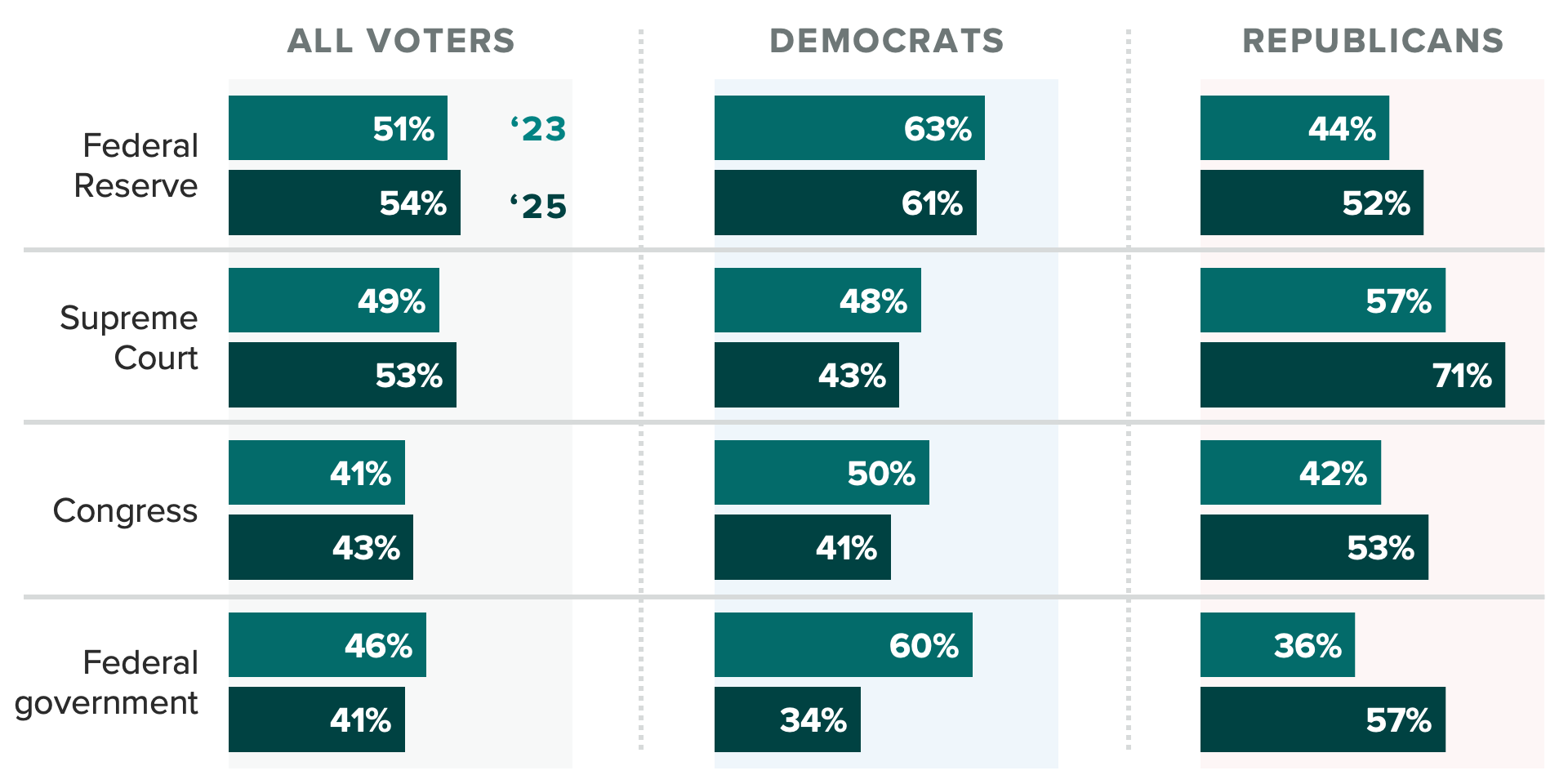
Our Sept. 6-8 survey found 54% of U.S. adults have “some” or “a lot” of trust in the Federal Reserve, up slightly from 51% back in late 2023. That leaves the central bank on similar footing as the Supreme Court, and far more trusted than Congress or the federal government in general. The public’s confidence in the Federal Reserve is underwritten by the trust of 61% of Democrats (in line with our 2023 reading) and 52% of Republicans (up 8 percentage points over the past couple of years). Two things about this are striking. First, Trump has been incessant with his attacks on Powell, but Republicans have actually grown more confident in the Fed since the president took office. And despite Trump’s public pressure campaign for lower interest rates and attempted firing of Fed governor Lisa Cook, a Biden appointee, we didn’t see Democratic support for the central bank rally. There are reasons to believe things may be coming to a head, despite the Fed’s recent move to lower rates. According to the Financial Times, “officials are increasingly worried that if the Supreme Court allows for Cook’s removal, even temporarily, it will give the president the green light to begin picking off the central bank’s most senior officials one by one.” That will test whether the public’s confidence can be shaken. But at this point, Trump’s Fed fight does not appear to be top of mind for the electorate, whose concerns about high interest rates have faded slightly.
Read more here from Sofia Baig about the public’s views on monetary policy.
|
|
|
2. INCREASING CONFIDENCE IN SCIENCE EXPERTISE |
Beyond the Fed, Trump has also laid siege to science and educational institutions by, among other moves, elevating vaccine-skeptic Robert F. Kennedy Jr. to lead the Department of Health and Human Services, drastically downsizing the Department of Education and cutting billions in research and grant funding. Those efforts, especially as it relates to Kennedy’s leadership and the Trump administration’s firing of the head of the Centers for Disease Control and Prevention, have garnered more reaction from the electorate than his efforts with the Fed. But what’s happened has done nothing to diminish Democrats’ faith in the scientific community and public educational system, and actually increased confidence among Republicans. |
Shares of U.S. adults who trust … |
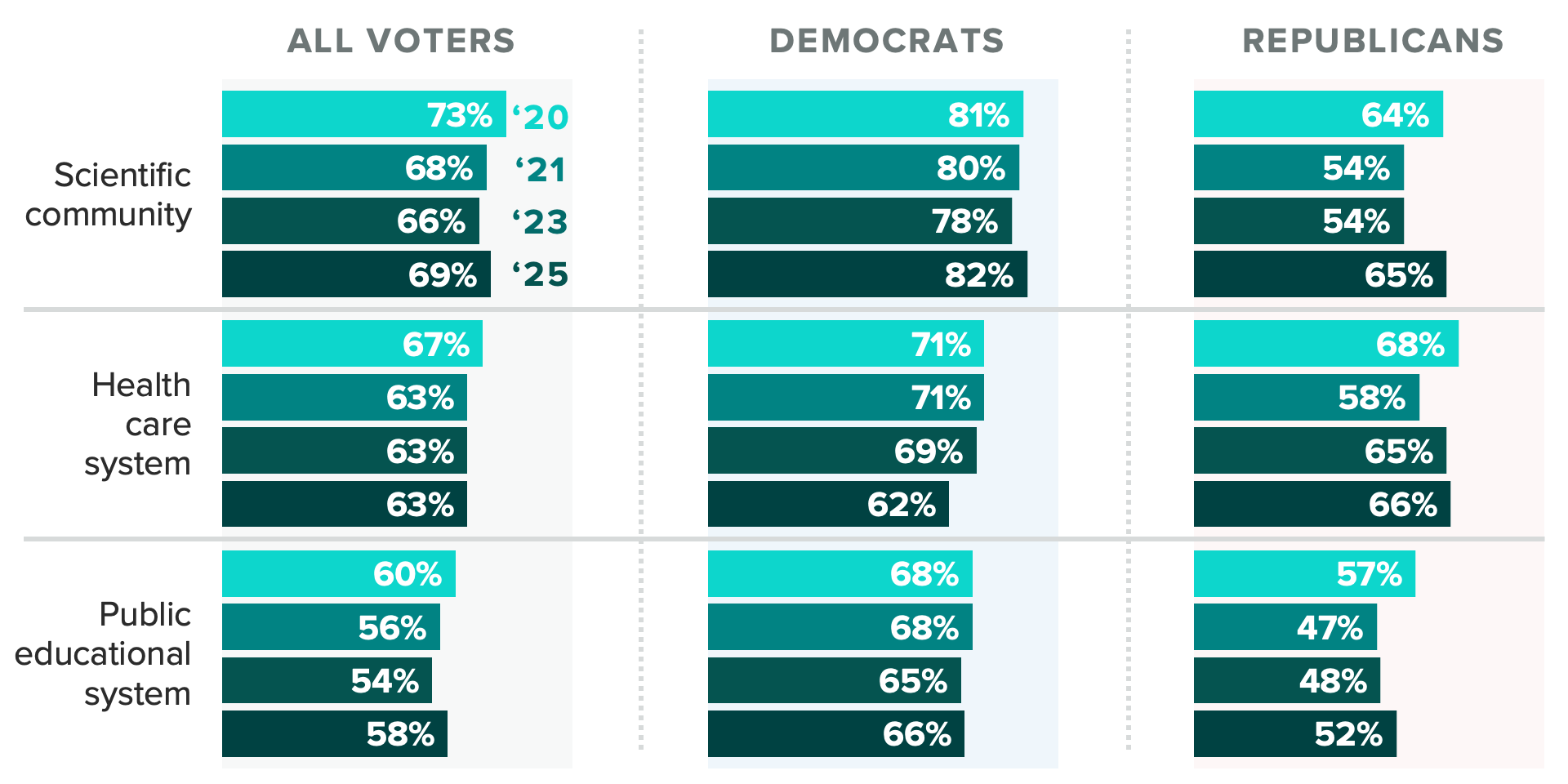
More than 2 in 3 Republicans (65%) said they trust the scientific community, up from 54% during Joe Biden’s presidency to roughly match where it was in late 2020. At the same time, 82% of Democrats said they trust America’s researchers, marking a 4-point improvement since 2023. When it comes to the public educational system, Republicans’ confidence hasn’t returned to its level at the end of Trump’s first term, but is elevated compared to the past few years. And among Democrats, trust in America’s public schools hasn’t really been hurt by Trump’s latest ascent, with 2 in 3 expressing confidence. Similarly to science and schools, Trump’s second term also hasn’t shaken the larger electorate’s trust in the health care system, though it has shifted sentiment along partisan lines. For the first time since the COVID-19 vaccine rollout in 2021, Republicans are more likely than Democrats to say they trust the health care system (66% to 62%). Democrats' trust is down from 71% at the end of Biden’s first year in office, while Republicans’ is up from 58%. Politics is almost certainly at play here, which by itself is concerning to public health activists and the industries they rely on. The good news for them is that Trump’s efforts to dismantle research efforts and educational institutions hasn’t harmed trust on the left, leaving a solid base of support for them moving forward. The Republicans’ improvement, on the other hand, is likely reflective of Trump’s mere presence in the White House and just how much his approach to the institutions has broken through. |
|
|
A MESSAGE FROM MORNING CONSULT |
Tracking Public Opinion of Trump's Washington Morning Consult is tracking what voters across the country think about how President Donald Trump and Republicans in Congress are governing the United States ahead of the 2026 midterm elections. Each week, we’ll update this page with fresh and timely data on all of the major questions facing Washington. See the data here. |
|
|
3. DEMOCRATS TURN ON CORPORATIONS AND BIG TECH |
No business leader was a bigger supporter of Trump’s 2024 campaign than Elon Musk. But the rest of corporate America, and specifically its Silicon Valley conglomerates, have made a big show of cozying up to Trump since his victory, with the tech barons' pilgrimage to Washington for Trump’s inauguration and other business leaders’ work to kiss the ring. This, it appears, has been noticed by both sides of the aisle. |
Shares of U.S. adults who trust … |
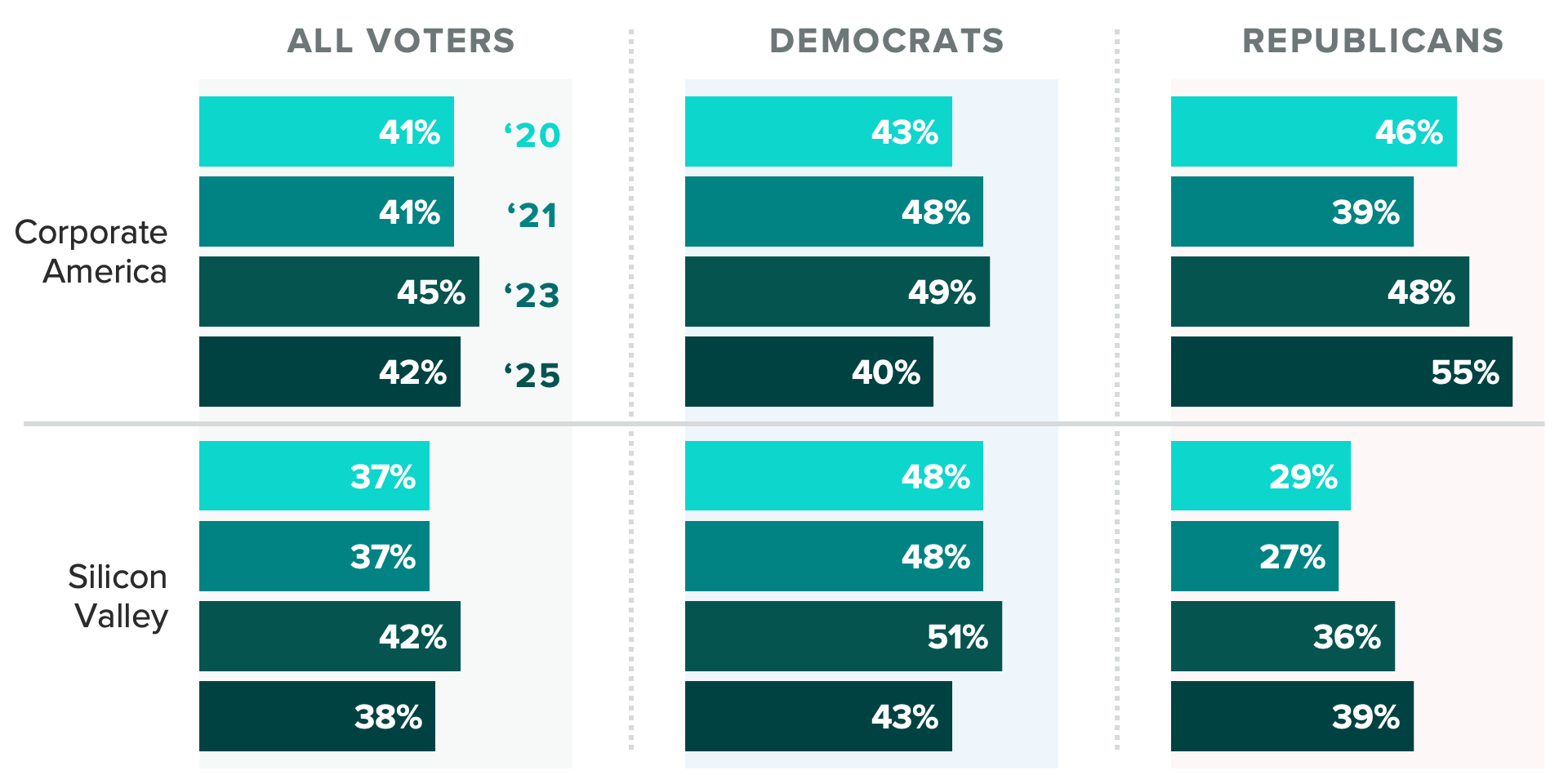
Just 43% of Democrats have confidence in Silicon Valley — down from 51% in 2023. On the other side of the aisle, the U.S. tech hub is now trusted by 39% of Republicans, up 12 percentage points since 2021, when major social media companies removed him from their platforms following the Jan. 6 Capitol attack. This same trend also holds for corporate America as a whole. Just 2 in 5 Democrats said they trust America’s major boardrooms, down from 49% in 2023, while trust among Republicans has grown 16 points to 55% as major brands have resisted the urge to publicly fight Trump following the fallout from Jan. 6. That all adds up to a partisan trust gap in corporate America that exceeds any other we’ve gauged so far. It’s worth noting that trust in Silicon Valley and the country’s business enterprises remains underwater among the larger public, but the tech industry, in particular, appears to face significant risk given the more bipartisan consensus. It’s no wonder that Americans were highly likely to blame social media for the environment that led to right-wing activist Charlie Cook’s assassination, for example, or that bipartisan cohorts of lawmakers have backed new regulations on artificial intelligence, considered new anti-trust enforcements or pressed for content moderation policies. While corporate America lacks much of the public’s trust, it’s Silicon Valley — a key driver of America’s economy today — that serves as an easy political punching bag for politicians on both sides of the aisle.
Read more from me about voters’ views on content moderation policies.
|
|
|
Government funding Ahead of Tuesday’s funding deadline, the Office of Management and Budget told federal agencies to come up with a list of potential layoffs for workers whose jobs aren’t financed by mandatory funds, didn’t get new money from the One Big Beautiful Bill Act or are “not consistent with the President’s priorities,” Punchbowl News reports. The administration’s shutdown prep comes as Democrats and Republicans still are not talking directly about how to keep the government running. The House, which passed a stopgap funding bill last week that runs into late November, isn’t planning to return until after Wednesday. Needless to say, a shutdown looks like the likeliest outcome at this point, though there’s still time for a course correction.. California AI rules Gov. Gavin Newsom (D-Calif.) signaled he will sign a big AI bill amid “intense lobbying from the industry and safety advocates alike,” per Politico, which framed his decision as a “major step at the state level that could help sow the seeds for a burgeoning national standard on AI safety.” After Newsom vetoed a larger AI measure last year, speculation is centered around an AI safety bill that got buy-in from Anthropic and didn’t face opposition from other major AI labs. H-1B visas Senate Judiciary Committee Chairman Chuck Grassley (R-Iowa) and the panel’s ranking member, Sen. Dick Durbin (D-Ill.), are pressing the country’s largest users of H-1B visas about why “they continue to hire thousands of H-1B visa holders while also cutting other jobs,” The Wall Street Journal reported, placing scrutiny on companies such as Amazon, Apple and JPMorgan Chase. These and other firms face an Oct. 10 deadline to respond. Senate GOP scrutiny Senate Majority Leader John Thune (R-S.D.) said there could be additional “explosive” Senate hearings with senior Trump administration officials following this month’s sparring with RFK Jr., according to The Hill. His comments came in response to a question about Trump’s recent threats to pull broadcast licenses from networks that air criticism of him, and his push for prosecution of his political opponents. |
|
|
|