President Donald Trump’s net approval rating improved 3 percentage points over the past week, with 46% approving and 51% disapproving in our latest tracker update. That improvement comes as the federal government’s Oct. 1 shutdown remains our most salient story for the third week in a row. It’s just the latest indication that, as we get into more below, the impasse on Capitol Hill may be full of sound and fury, but signifies nothing for the average voter. |
Just over a third of voters said Trump should prioritize deportations of undocumented immigrants, in line with our findings since before his militarized campaign against illegal immigration in major cities began in August as his approval rating on the matter has rebounded from recent lows. The administration is on track to shatter the annual record for the number of undocumented immigrants deported from the United States, Fox News notes. |
Less than a quarter of voters have seen, read or heard “a lot” about Trump’s construction of a new $250 million ballroom at the White House, but that might soon increase. As The Washington Post reported yesterday under a striking image shared by a source, demolition crews began ripping down part of the presidential mansion’s East Wing despite Trump’s pledge that the pending 90,000-square-foot structure wouldn’t interfere or touch the existing building. |
|
|
Shutdown Trump is set to host Senate Republicans for lunch at the White House today “to celebrate their unity in the government shutdown fight and for passing nominees,” according to Politico, which noted that the party’s push for a Nov. 21 funding extension may need to change as Washington gets closer to the expiration date. Some conservatives are said to be pushing for a continuing resolution that would run until March or even next October, though the idea irks Senate Appropriations Committee Chair Susan Collins (R-Maine). Perhaps most notably: NOTUS reports that some Republican senators — even Collins herself — are beginning to entertain the idea of employing the nuclear option to pass a continuing resolution with a simple majority. On the Obamacare front, Politico also reports that Republicans are ramping up talks with the White House on what kind of premium tax credit expansion the party could support once the government is reopened. The party is said to be considering a year-end health care policy package with a two-year extension of scaled-back ACA subsidies though it’s uncertain how that would be received in the House. Nominees The New York Times reports that Senate Majority Leader John Thune (R-S.D.) is among at least four Republican senators who have come out in opposition to Trump’s nomination of Paul Ingrassia to lead the Office of Special Counsel following a Politico report documenting a series of racist text messages. That’s enough Republicans to kill Ingrassia’s nomination even before his planned testimony to the Senate Homeland Security and Governmental Affairs Committee on Thursday. Separately, Axios noted that Trump has paused the nomination of former Florida Deputy Attorney General John Guard to fill an open open judicial seat in the Middle District of Florida over his connection with a criminal probe, and The Wall Street Journal points out a “power struggle” between Transportation Secretary Sean Duffy and Elon Musk-aligned billionaire Jared Isaacman over the stewardship of NASA. Gerrymandering House Democratic leaders in Washington have devised a new congressional boundary map for Illinois that would target Republican Rep. Darin LaHood, aiming to reduce the state’s GOP-leaning districts to two, Punchbowl News reports on the party’s response to GOP gerrymandering efforts. Legislators will be in a veto session next week, but will have to move fast ahead of Illinois' pending filing deadline or move next year’s primary date. U.S.-China Trump has rolled out a list of topics he expects to discuss when he meets next week with Chinese President Xi Jinping on the sidelines of the Asia-Pacific Economic Cooperation summit in South Korea. He pointed to rare earth minerals, fentanyl, soybeans and Taiwan, “underlining the divisive topics the two sides plan to tackle at the negotiating table as a fragile trade truce nears its expiration,” as Bloomberg News put it. |
|
|
A MESSAGE FROM CVS HEALTH |
Where you get your medicine matters Whether it’s late at night, on the weekend, or when you need a trusted professional by your side, CVS Health is here when it matters most. Our dedicated pharmacists in your neighborhood make picking up your prescriptions easy and affordable. Learn more about how we’re working every day, with you, to keep you healthy, all while lowering the cost of care. |
|
|
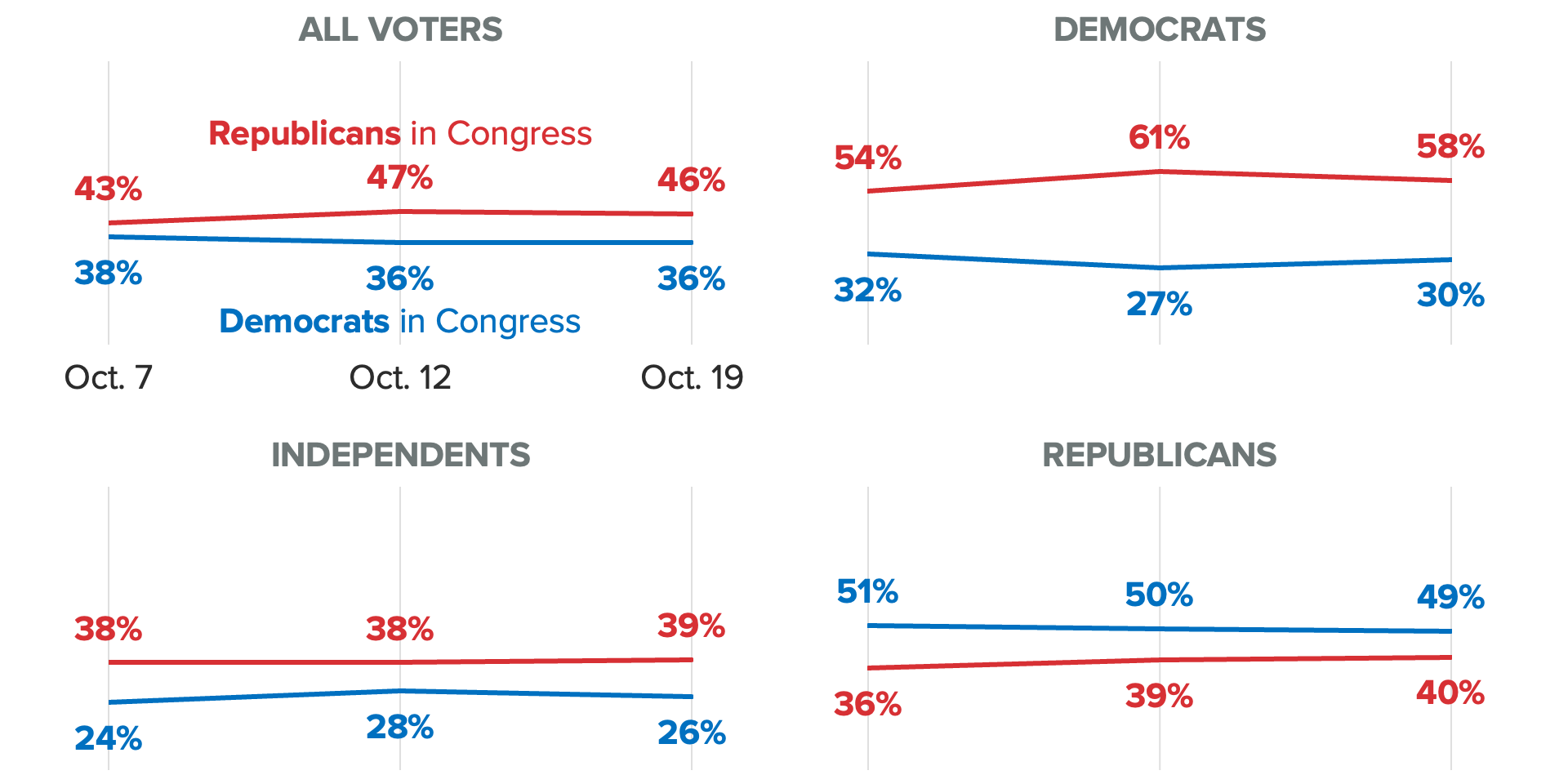
The stalemate between Republicans and Democrats on Capitol Hill over how to reopen the federal government is mirrored by how voters are analyzing what’s happening in Washington. The situation is largely unchanged since we checked in on which side voters blame, and neither have the numbers. Our fresh tracking data shows that voters are 10 points more likely to say responsibility for the shutdown lies with Republicans in Congress rather than Democrats (46% to 36%), in line with the 11-point spread we measured last week. |
Shares of voters who blame the following for the shutdown: |
Republican voters, who began the shutdown blaming Democrats by a 15-point margin, are only 9 points more likely to do so today. They’re also 10 points more likely to blame their own side of the aisle than Democrats are (40% to 30%), compared with a 3-point gap we measured in the first survey. While voters are more likely to blame Republicans on Capitol Hill for the shutdown, very little has changed about their popularity, or the popularity of Democrats in Congress. On the political front, our read on the generic congressional ballot went unmoved over the past week, with 46% of voters indicating their support for the hypothetical Democratic candidate and 43% backing the unnamed Republican candidate if the midterm elections were held today. By these metrics, the party out of power is winning the shutdown fight — or at least holding its own — when it comes to public sentiment. But Washington’s standoff, to date, has left many Americans thinking a lot like they did before the shutdown began.
See our latest tracking of public opinion on Trump’s Washington.
|
|
|
The rapid proliferation of data centers fueling the growth of artificial intelligence in the United States has left public officials on both sides of the partisan aisle and energy companies alike blaming the tech industry for the rising cost of consumer electricity. While public opinion is mixed over whether their construction should be halted, our new survey shows many voters are holding the industry responsible amid concerns about the short-term downsides of the energy-guzzling tech’s impact on household energy bills. |
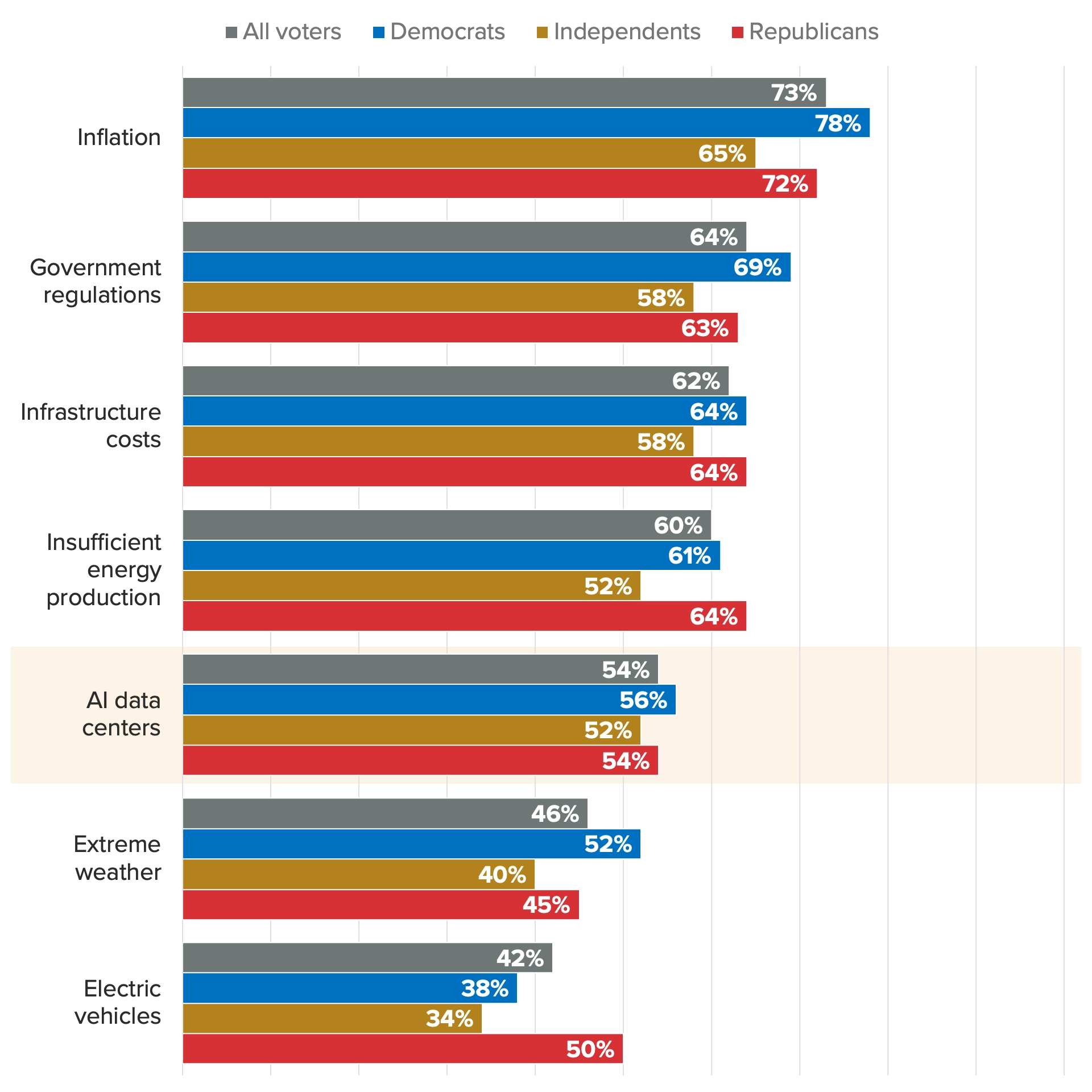
Shares of voters who said the following are responsible for the increasing price of electricity for households: |
A majority of voters (54%) say data centers that support AI are “very” or “somewhat” responsible for the increasing price of electricity for households, including nearly equal shares of Democrats or Republicans. To be sure, more voters (60%) blame insufficient energy production, with little partisan variation. But as these AI-related construction projects continue to take off in the country amid a NIMBY movement among some localities to stop them, the bulk of voters (45%) say AI data centers have adverse effects on the price of electricity and the power grid (42%). The answer here isn’t simple. While AI companies using natural gas at their own generation facilities may weigh on the consumer market, those building their own nuclear or geothermal energy systems are additive, which could avert voter blowback. What is clear is that though voters don’t like AI-related energy cost hikes, nor is there consensus about how to address it.
Read much more from my big dive here.
|
|
|
A MESSAGE FROM CVS HEALTH |
Whether it’s late at night, on the weekend, or when you need a trusted professional by your side, CVS Health is here when it matters most. Our dedicated pharmacists in your neighborhood make picking up your prescriptions easy and affordable. Learn more about how we’re working every day, with you, to keep you healthy, all while lowering the cost of care. |
|
|
|