Morning Consult captures the leading indicators of consumer intent every day, across global markets, and delivers them through always-on intelligence and custom research built for speed, confidence, and growth. Leaders from the world's largest companies, equity research firms, hedge funds, and the Federal Reserve rely on our 30,000 daily survey interviews in 100+ countries covering more than 5,000 brands, economic indicators, and risk metrics. See the research in action. This week's briefings payment platforms. |
|
|
BOTTOM LINE UP FRONT: PayPal is the category's mental shortcut, and it turns that advantage into more usage than it's already strong brand measures would otherwise indicate. It captures 29.7% of all mental market share, enters the consideration set on 82.5% of occasions, and carries the widest occasion network of any brand (10.02 of 22). What sets it apart is conversion: PayPal's real usage share of 36.3% runs 6.6 points ahead of its mental share, the deepest positive gap in the category. This is a brand extracting more value from its mental footprint than any competitor. The growth question for a brand this dominant is not how to convert availability into usage, because it already over-converts. It is which occasions to extend into next. The data gives a clear answer: PayPal's efficiency concentrates in online, money-management, and trust occasions, and it is structurally weak at the device-native register it is unlikely to win head-on. The move is to press the strengths and treat the phone as contested ground to work around, not attack. In this briefing, we use the Category Advantage research framework. A few terms you should know: |
- Mental Market Share (MMS) measures a brand’s "mental availability"—how often it comes to mind, compared to competitors, when consumers think of buying in a category
- Category Entry Points (CEPs) are the specific needs, motivations, situations, or feelings that trigger a consumer to consider a product category and the brands within it
- Network Size refers to the average number of distinct usage occasions or buying situations that consumers mentally associate with a brand
|
| |
Across every headline mental-availability metric, PayPal leads the category. Its lead is not narrow, and its conversion of that lead into real usage is what separates it from the field. The gap analysis is the headline, not the footnote. Read alongside its 29.7% mental share, PayPal's 36.3% usage share means the brand is chosen in the real world more often than its mental availability would predict — a −6.6 gap that is the largest over-conversion in the category. For context, Apple Pay runs the opposite way (+2.8: more mental share than usage), and Cash App, Venmo, and Zelle all over-convert only slightly (−1.2 to −1.6). PayPal alone converts at scale. A brand that already turns availability into disproportionate usage does not grow by buying more awareness; it grows by widening the set of occasions it is available for. Breadth is the structural moat. That breadth is why no single competitor threatens PayPal everywhere at once; each rival contests one corner of the map while PayPal holds the whole of it. |
|
|
Access the 12 brand-specific
memos about payment platforms |
This week our briefings cover payment platforms at the category level. In addition to these category insights, our team has assembled 12 brand-specific memos — including on brands such as the Zelle, Google Pay and Affirm. If you're interested in learning more about this data or would like a briefing on a specific brand, get in touch. |
|
|
The Occasions PayPal Owns |
Note: These scores in this table are based on the full set of brands we ran our study on, not just the brands listed in the headers at the top. To see the full table, get in touch. |
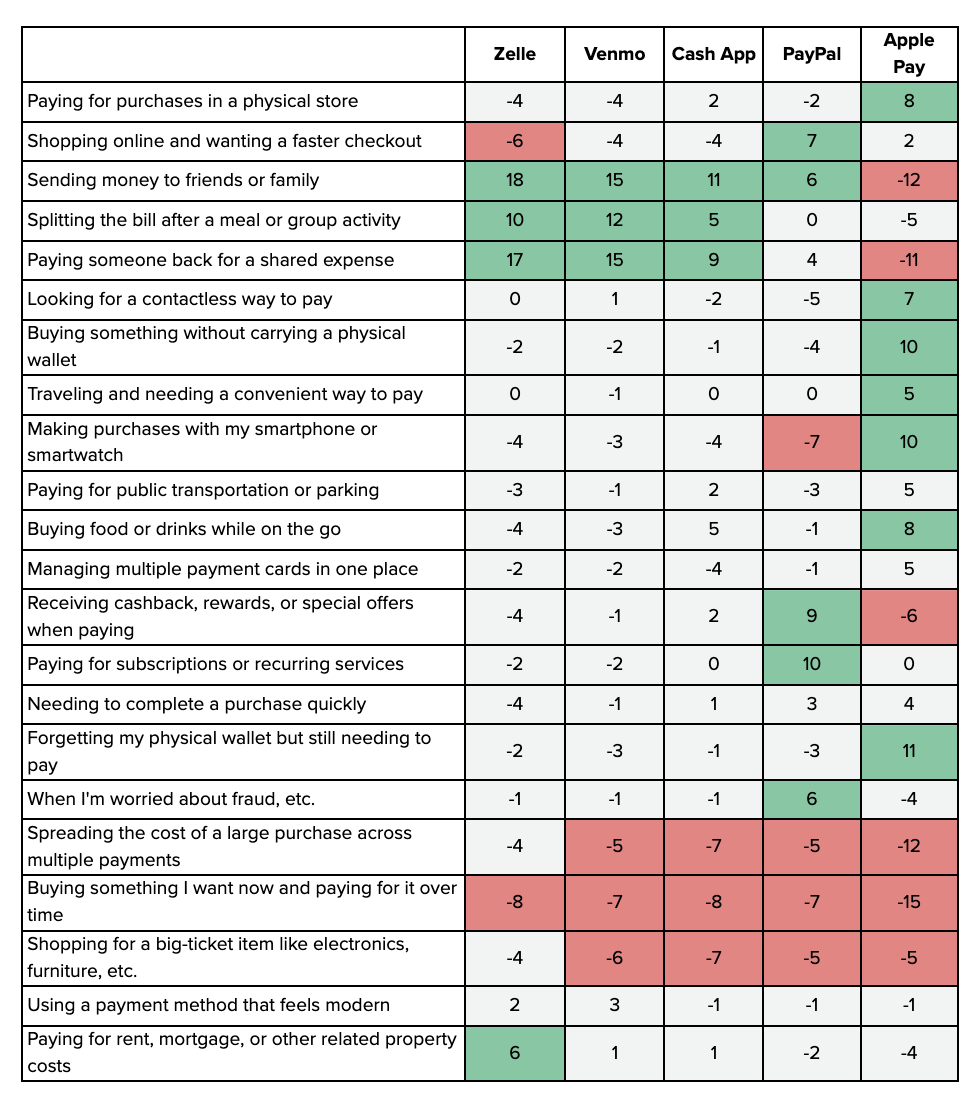
Efficiency concentrates online and around money management. Absolute leadership is easy for a brand this large, so the sharper read is Mental Advantage, which measures whether PayPal is associated with an occasion more than its size alone would predict. On that efficiency-adjusted basis PayPal over-indexes on five occasions: paying for subscriptions and recurring services (+9.57), receiving cashback and rewards (+9.31), faster online checkout (+6.54), sending money to friends or family (+6.45), and paying when fraud or financial security is the worry (+5.76). PayPal also holds the highest raw association rate on all five — 42.8% on subscriptions, 43.6% on cashback, 46.6% on checkout, 47.5% on sending money, and 39.8% on fraud-safety. These are online, recurring-commerce, and trust occasions, and they are where extension is cheapest because the brand already punches above its weight. The pattern is a strategic asset, not a list. Subscriptions, cashback, checkout, P2P, and fraud-safety share a logic: they are the moments where a consumer wants a trusted account standing between them and a merchant or another person. That is PayPal's native territory, built over years as the default online account. The adjacent occasions it does not yet own efficiently — managing multiple cards, rent and recurring property costs, completing a purchase quickly — sit close to this cluster and are the natural next targets. |
|
|
PayPal's mental share deepens with age. Its mental market share runs 22.7% among 18–34, 28.5% among 35–44, 33.6% among 45–64, and 37.4% among 65+. The brand is genuinely universal, but its center of gravity is older, and among the youngest cohort its lead narrows: Cash App (19.3%) and Apple Pay (19.2%) both sit within a few points of PayPal's 22.7% at 18–34, a proximity that does not exist at the top of the age curve. PayPal's dominance is real today and strongest where lifetime value is already established; the contested edge is with the youngest users, where the device-native and social-native challengers press hardest. |
|
|
The device-native register is the structural gap. PayPal under-indexes on four occasions, and they split by cause: buying now and paying over time (−7.22) is owned outright by Afterpay on absolute association (37.8%, ahead of Affirm's 34.0% and PayPal's 33.4%), and paying by smartphone or smartwatch (−6.52) is the one device-native moment where Apple Pay out-associates PayPal (40.2% vs. 34.0%) and carries the category's largest conversion headroom (+2.8 gap overall). The remaining two, spreading cost across payments (−5.44) and shopping for a big-ticket item (−5.12), are occasions where PayPal still leads on absolute association (33.7% and 34.2%) but earns that lead less efficiently than its size would predict, a sign these installment-adjacent occasions are harder for it to own than its online core. Independent survey work from McKinsey finds consumers consolidating toward a single device-native wallet as in-store acceptance widens — a structural headwind for an app-based wallet at the physical point of sale. This is contested ground to work around, not to storm. The device-native occasions are where PayPal's equity is weakest and a hardware-default competitor's is strongest. A head-on contest for tap-to-pay at the register is the one fight the data suggests PayPal is positioned to lose. The more productive read is that these occasions bound PayPal's natural territory rather than define its next growth. |
|
|
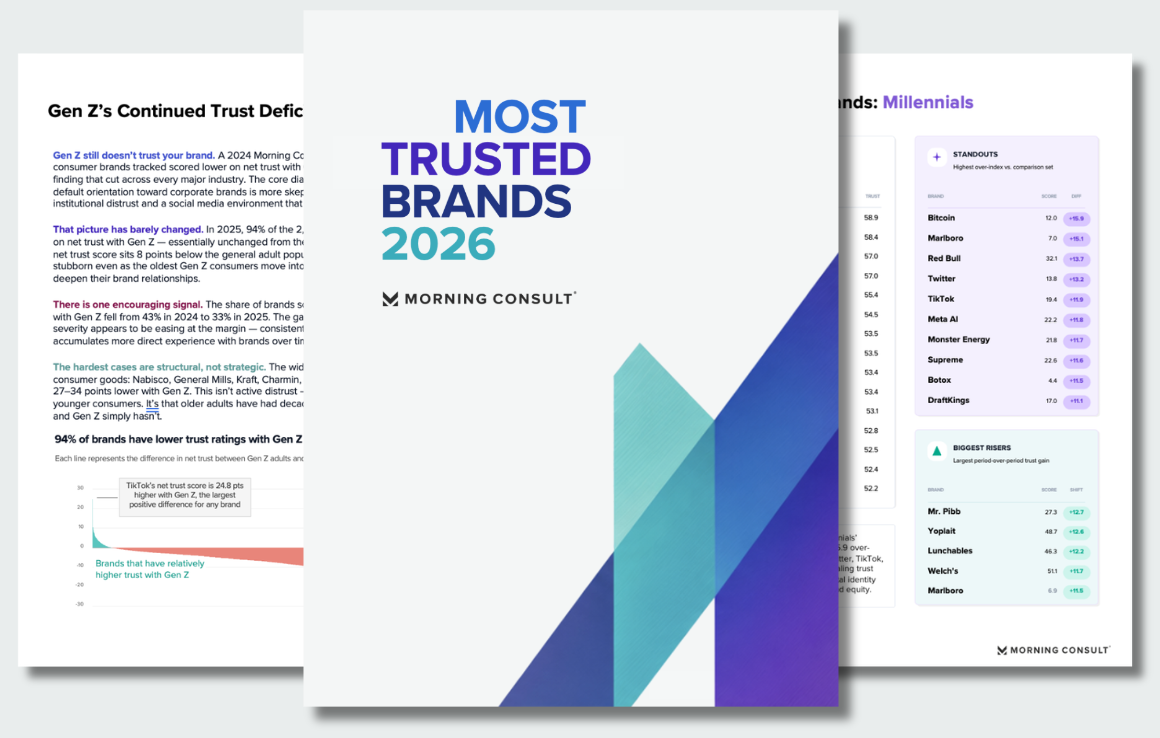
Download: Most Trusted Brands 2026 |
Our annual ranking of the brands that are winning consumer trust is live. The 2026 Most Trusted Brands report covers over 180 consumer brands across 30 different rankings. |
|
|
Extend from the owned cluster, not into the device. PayPal's cheapest growth is the ring of occasions adjacent to its five efficiency wins — managing multiple cards, recurring property and rent payments, completing purchases quickly — where it already leads on association but has not yet built efficiency. Building deliberate association on these online and money-management-adjacent moments compounds the strength PayPal already has, rather than spending against a device-default it cannot dislodge. Defend the trust and P2P occasions against the youngest cohort. Sending money and fraud-safety are PayPal's owned occasions, but the 18–34 band is where Cash App and Apple Pay close to within a few points on total mental share. Protecting the P2P and security associations specifically among younger users is where the competitive threat and PayPal's equity intersect most directly, and where erosion would be most costly to lifetime value. Partner or fund into the device rather than fight it. On the smartphone and contactless occasions PayPal under-indexes, the realistic path is presence through the hardware default — network-branded cards inside device wallets, or funding-source integration — rather than a branded-wallet contest at the terminal. The goal on these occasions is to be the money behind the tap, not the brand on the screen. Treat the conversion surplus as the story, not the ceiling. PayPal's −6.6 gap says its mental availability is under-supplying its real demand: consumers reach for it even more than they think of it. That is a durable position, and the risk is complacency. Keeping it means widening the occasion set the brand is mentally available for, so usage has more to convert from as the category's youngest and most device-native occasions grow. |
|
|
Most research tells you what already happened. Morning Consult tells you what's coming. |
Most organizations are making decisions on research that wasn't built for the speed at which consumers and markets change today. Data is slow. Insights are fragmented. By the time analysis reaches leadership, the moment has already passed. Morning Consult changes that. From brand health and spending behavior to economic sentiment and political trends, we track the signals that move markets every day, so your team sees shifts coming before they show up in your numbers. |
|
|
One Always-On Consumer Signal. Two Complementary Solutions:
1. Intel Platform: AI-driven consumer and market research platform that transforms daily consumer surveys into clear, stakeholder-ready insight - helping leaders continuously monitor change and move from data to decision, faster.
2. Custom Research: On-demand market research built on the most advanced survey research technology to deliver solutions that are fast, scalable, cost-efficient, and built for action. |
|
|
|