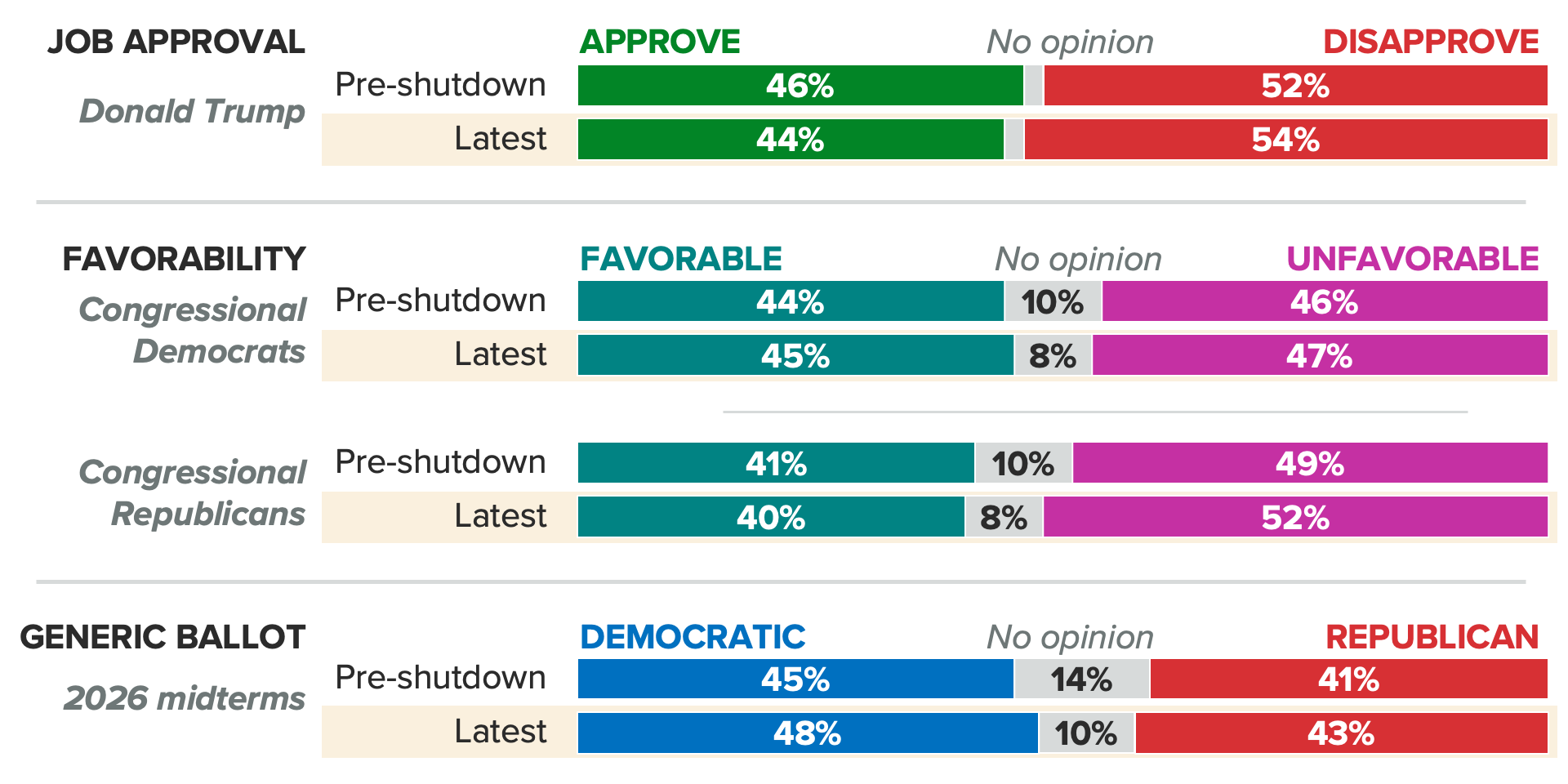
Voters are 10 points less likely to approve than disapprove of President Donald Trump’s job performance, setting a record low since he took office in January as Washington inches closer to a deal to reopen the government, according to our latest tracking update. (More on all of this below.) It comes as perceptions of Trump’s handling of health care and the economy also reached new 2025 lows over the weekend following weeks of Democratic attacks that produced the worst news environment for him in his second term. |
Just 35% of voters heard a lot about the Trump administration’s announcement that it would issue some SNAP funding under judicial order, far less than the 61% who reported hearing about the initial funding lapse in our prior survey. The New York Times reported yesterday that the Trump administration returned to court to try to block full federal funding for food stamps, “seeking to stymie the nation’s largest anti-hunger program even as the government shutdown neared its end.” |
Nearly 3 in 4 voters (73%) said the Trump administration should make reducing health care costs a “top priority,” matching a record high since he took office and tying the share who said the same of other consumer prices more generally. In Washington, Politico reports that “Republicans appear to be quickly pivoting from the debate around Affordable Care Act tax credits to developing their own health policy agenda,” reopening a fraught political debate that hurt the party during Trump’s first term. |
|
|
Government funding The House Rules Committee is poised to meet as soon as tonight to mark up a continuing resolution that would fund the government through January, per Punchbowl News, after eight Senate Democrats joined Republicans to pass the measure last night. This sets up a full House vote as soon as tomorrow. While Trump’s backing for the package is likely enough to get it across the finish line, House Speaker Mike Johnson (R-La.) can likely only afford to lose three Republicans. Epstein files Before the stopgap vote, Rep.-elect Adelita Grijalva (D-Ariz.) is set to be sworn into office seven weeks after her special election victory. As Politico points out, this sets the stage for her decisive signature on a discharge petition that would force the chamber to vote on a measure requiring the Justice Department to release records related to its investigation into sex trafficker Jeffrey Epstein. Crypto bill Senate Agriculture Committee Chairman John Boozman (R-Ark.) and Sen. Cory Booker (D-N.J.) proposed a discussion draft for legislation that would advance an industry priority of shifting cryptocurrency oversight from the Securities and Exchange Commission to the Commodity Futures Trading Commission, according to Bloomberg News. The market structure legislation is a major priority for Senate Banking Committee Chairman Tim Scott (R-S.C.), who will also need to steer it through his own panel. |
|
|
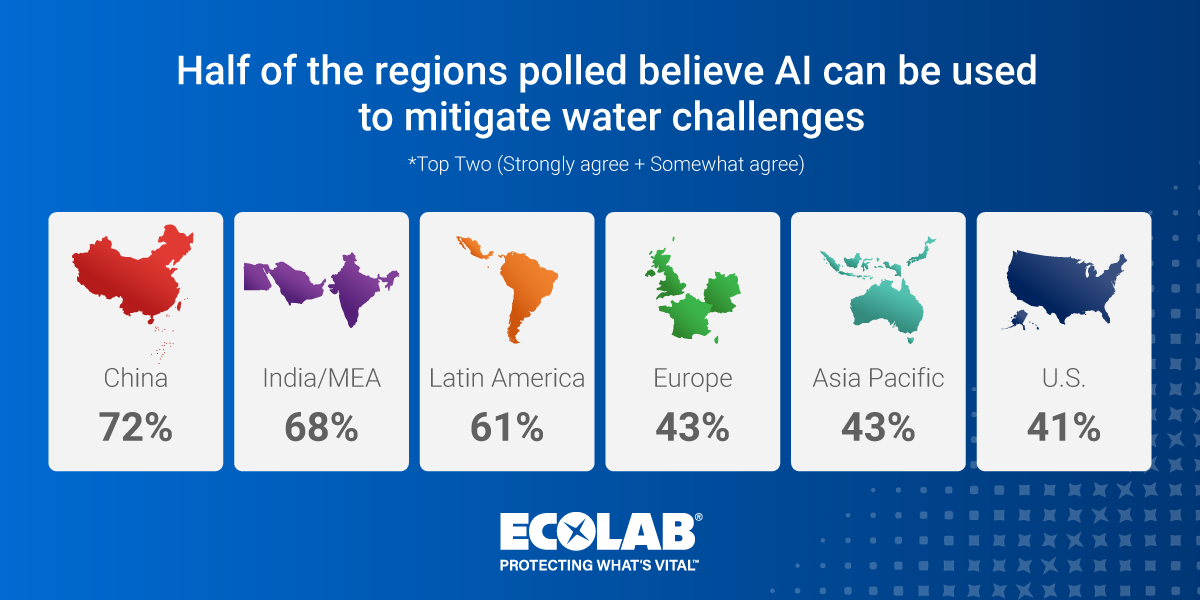
The 2025 Ecolab Watermark™ Study Connects AI Growth to Global Water Security Most consumers acknowledge AI's significant power and energy consumption, but fewer recognize its water use. This year’s findings also reveal that over 67% of consumers across regions expect business investment in technologies that make water resources more resilient. The Ecolab Watermark Study measures the state of water stewardship through its usage and connection to global trends, such as artificial intelligence and smart water management among key consumer populations around the world. ACCESS THE FULL REPORT |
|
| Senate Minority Leader Chuck Schumer (D-N.Y.) is facing calls for his ouster from some on the left after he didn’t prevent a handful of Senate Democrats from joining Republicans to advance stopgap legislation to end the shutdown. Citing concerns about health care, Rep. Ro Khanna (D-Ca.) said Schumer was “no longer effective,” POLITICO reported. Our latest survey suggests Schumer’s detractors are armed with plenty of data points to help make the case that they were winning in the court of public opinion. |
Trump’s job approval rating, party caucuses’ favorability ratings, and which party’s candidate voters expect to back in the midterms: |
As we mentioned at the top of this newsletter, Trump’s approval rating has reached a record low. Congressional Democrats have recovered from an initial hit to their brand at the beginning of the shutdown and Republicans in Congress have become more popular. And after a few weeks of stability, Democrats have seen some positive movement on the generic congressional ballot since we tested in August. On top of that, our latest tracking showed that more voters continue to believe Republicans are at fault for the shutdown than Democrats (46% to 38%) as buzz about Trump and health care issues worsened week over week. Of course, these dynamics will likely change over the next year as the campaign for control of the House and Senate kicks into full gear. When it comes to Democrats’ chief policy demand, the extension of enhanced Obamacare premium tax subsidies, we’ll still have to see whether Republicans, particularly those in the House, allow it to happen. Just yesterday, House Speaker Mike Johnson (R.-La.) wouldn’t commit to a vote when pressed by CNN’s Jake Tapper. Amid questions about the effectiveness of Democratic congressional leaders, what is clear today is that when it comes to the political environment, this shutdown has been bad for the GOP — offering both Schumer’s supporters and detractors fodder over the coming debate about his tenure.
See our latest tracking here.
|
|
|
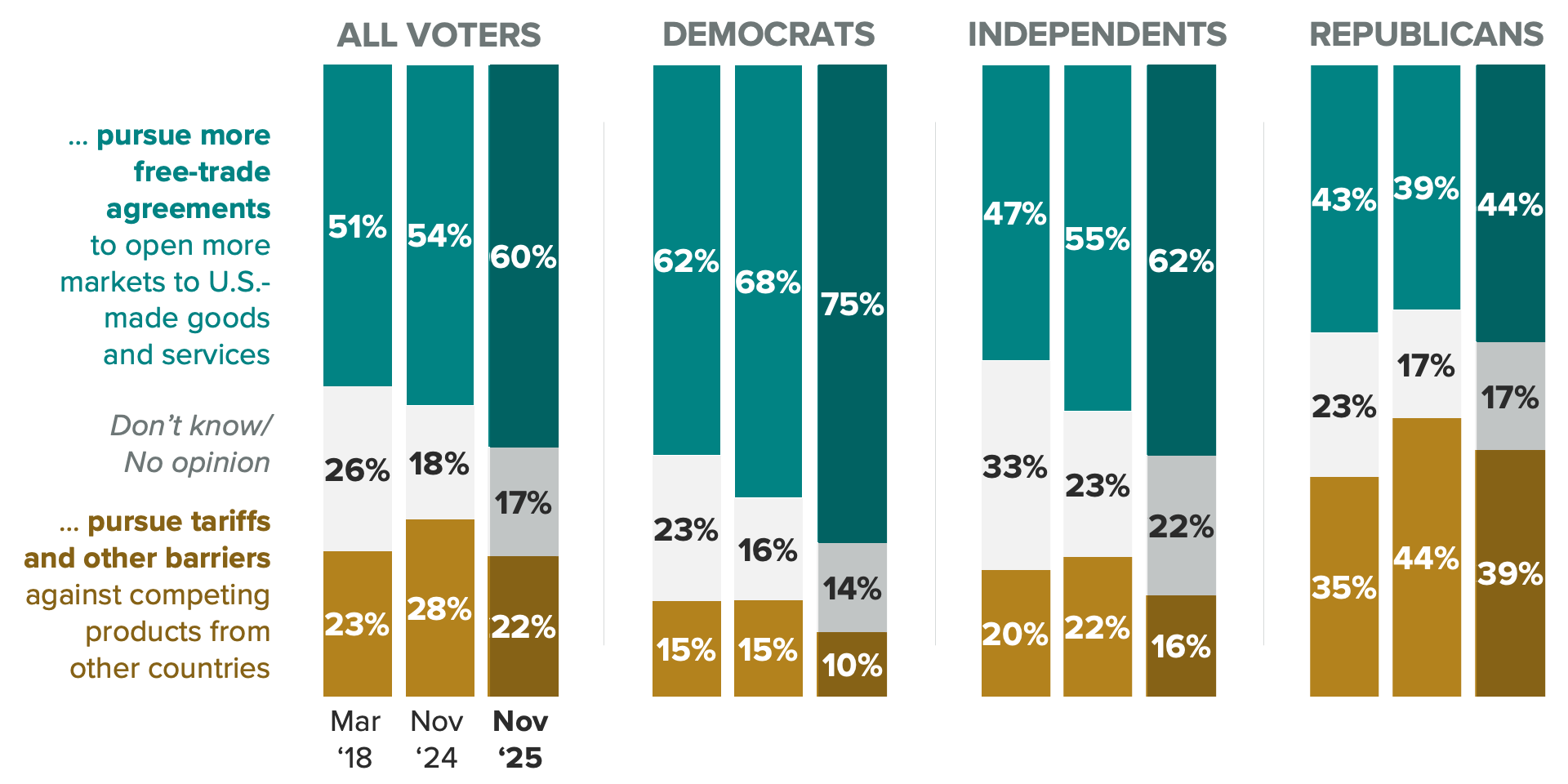
As Americans have soured on Trump’s protectionist approach to trade policies, our trend data shows that some have also shifted their tune on the larger ideological question about free trade. Three in 5 voters now say the government should pursue more free-trade agreements to open additional markets to American-made goods and services. That’s up from 54% who said the same just after Trump’s victory a year ago, and up from 51% in a March 2018 survey after Trump announced levies on steel and aluminum imports. Just over 1 in 5 voters (22%) said they want the government to pursue more tariffs and other barriers, down from 28% in 2024 and 23% in 2018. |
Shares of voters who said the government should … |
The most striking movement came among Republicans, who remain divided over the best route but are now — for the first time since 2018 — more likely to favor free trade than tariffs. That’s not to say that Republicans’ shift is primarily motivated by opposition to Trump’s approach. To the contrary, other long-term trends suggest it’s just as plausible that they are reacting to the framework agreements touted by the president this year. As our data shows support for free trade is increasing and that people want Trump reined in on his tariffs agenda, advocates for free trade in Congress and those fighting for varied industries could see a clean case to make to the base-focused leader of the world’s largest economy: Many Republican voters now think trade deals are good, because of him.
Read more from me here.
|
|
|
The 2025 Ecolab Watermark™ Study Connects AI Growth to Global Water Security
Most consumers acknowledge AI's significant power and energy consumption, but fewer recognize its water use. This year’s findings also reveal that over 67% of consumers across regions expect business investment in technologies that make water resources more resilient. The Ecolab Watermark Study measures the state of water stewardship through its usage and connection to global trends, such as artificial intelligence and smart water management among key consumer populations around the world.
ACCESS THE FULL REPORT |
|
|
|