Roughly half of voters (48%) say they think it’s at least somewhat likely that the government shuts down tomorrow, according to our new survey, ahead of tonight’s deadline for lawmakers to act to avert a funding lapse. Per Punchbowl News, that’s also the general consensus in Washington: The Senate does not appear to have the votes to clear a stopgap bill to keep the government running through Nov. 21, and the House is not in session. (Much more below on whom voters plan to blame for a shutdown.) |
Voters are 16 percentage points less likely to trust Republicans in Congress to handle health care than congressional Democrats, tying a record low in our tracking since the November elections. As Democrats press to extend the enhanced Obamacare premium tax credits in the shutdown fight, Axios reports that Sen. Roger Marshall (R-Kan.) “is sketching out an early compromise plan for ACA subsidies that he could eventually support,” though he thinks “most of the Senate GOP conference is nowhere near consensus.” |
That’s the share of voters who approve of Trump’s job performance, while 52% disapprove, our latest weekly tracking data shows. Those figures are unchanged over the last two weeks as the president has improved his standing a bit on a number of issues — something this week’s events will undoubtedly put to the test. |
|
|
Shutdown watch Senate Republicans plan to “keep voting on a seven-week funding extension until Democrats eventually capitulate,” according to CNN, believing that political pressure will ultimately force Democrats to back down. But Punchbowl News theorized that “we’re in for a long shutdown,” especially given pressure from liberal activists on Senate Minority Leader Chuck Schumer (D-N.Y.). For those of you on the Hill, the House Administration Committee released a handy new guidance on legislative operations during a lapse in appropriations. When it comes to other federal employees, Bloomberg News reports on the Trump administration’s preparations for more than 400,000 employees to be sent home as nonessential while steering clear of talk of permanent mass firings. Israel/Hamas war Hamas and other Palestinian factions are set to respond tomorrow to Trump's plan to end the war in Gaza, per CBS News, which cites a source that says the militant group is leaning toward accepting the deal. While visiting Trump at the White House yesterday, Israeli Prime Minister Benjamin Netanyahu appeared to publicly accept the agreement that would require the return of Hamas-held hostages, an increase in humanitarian aid and the eventual transfer of Palestinian territory to a group overseen by an international "Board of Peace" chaired by Trump. New tariffs Trump said he will impose a 100% tariff on all films produced overseas, a move that could disrupt Hollywood's global business model but faces uncertainty over legal authority and implementation, Reuters reported. When Trump first floated this idea in May, our survey found that just 36% of voters supported the film tariffs, marking the lowest level of initial support for any tariff we’d tested at the time.
Also yesterday, CNN writes that Trump placed a 10% tariff on lumber and a 25% tariff on furniture and cabinets, adding potential cost hikes for homebuilding and furnishing projects that are already facing price increases.
|
|
|
A MESSAGE FROM MORNING CONSULT |
Tracking Public Opinion of Trump's Washington Morning Consult is tracking what voters across the country think about how President Donald Trump and Republicans in Congress are governing the United States ahead of the 2026 midterm elections. Each week, we’ll update this page with fresh and timely data on all of the major questions facing Washington. See the data here. |
|
|
We showed you in Thursday’s newsletter how Republicans have driven an uptick in confidence in some Washington institutions, which wasn’t so surprising given the GOP’s governing trifecta. But as we dug into the data a little more, another thing that stood out to us is what’s happening at the local level. |
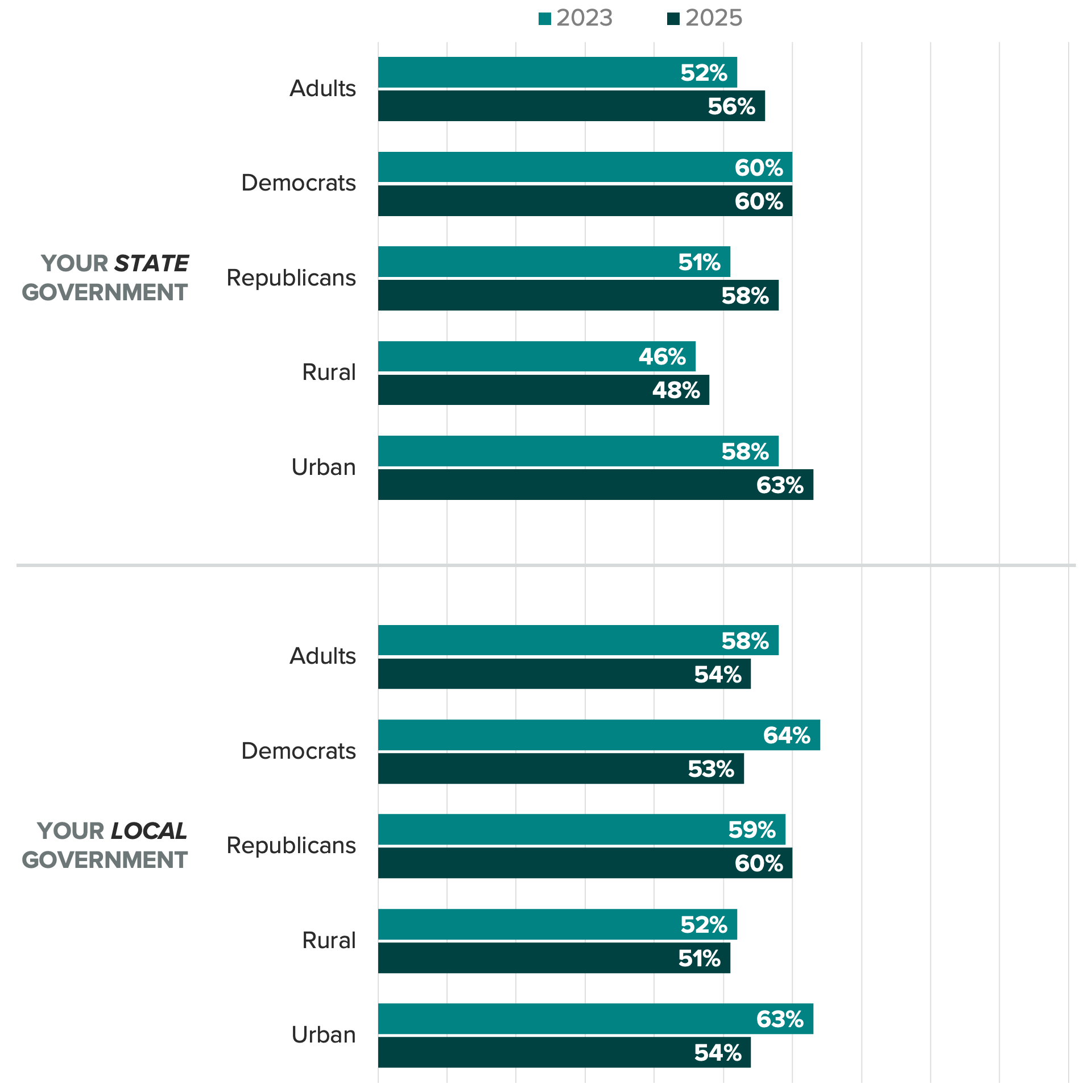
Shares of U.S. adults with “some” or “a lot” of trust in … |
Since 2023, Democratic trust in local governments has fallen from 64% to 53%, while Republican trust has grown from 51% to 58%. This movement came as confidence in state-level governments went mostly unchanged among Democrats, while Republicans have become a bit more trusting. This shift in perceptions of local authorities may be explained, at least in part, by a decline in trust among those who reside in urban communities, and comes after a presidential election in which urbanites nationwide moved nearly 7 points to the right, according to The New York Times. While Americans’ concerns about institutions often appear driven by partisanship more than anything else, the diminishing confidence among Democrats and urbanites in their local governments is something the party ought to take seriously if it wants to arrest their recent slide in support from their traditional strongholds.
Read more about our tracking of institutional trust.
|
|
|
Both Republican and Democratic leaders in Washington have spent the past few weeks trying to frame a familiar narrative around government shutdowns: It’s the other side’s fault. A new Morning Consult survey suggests it’s Democrats who have been a bit more successful in making their case in the court of public opinion, our latest survey shows. |
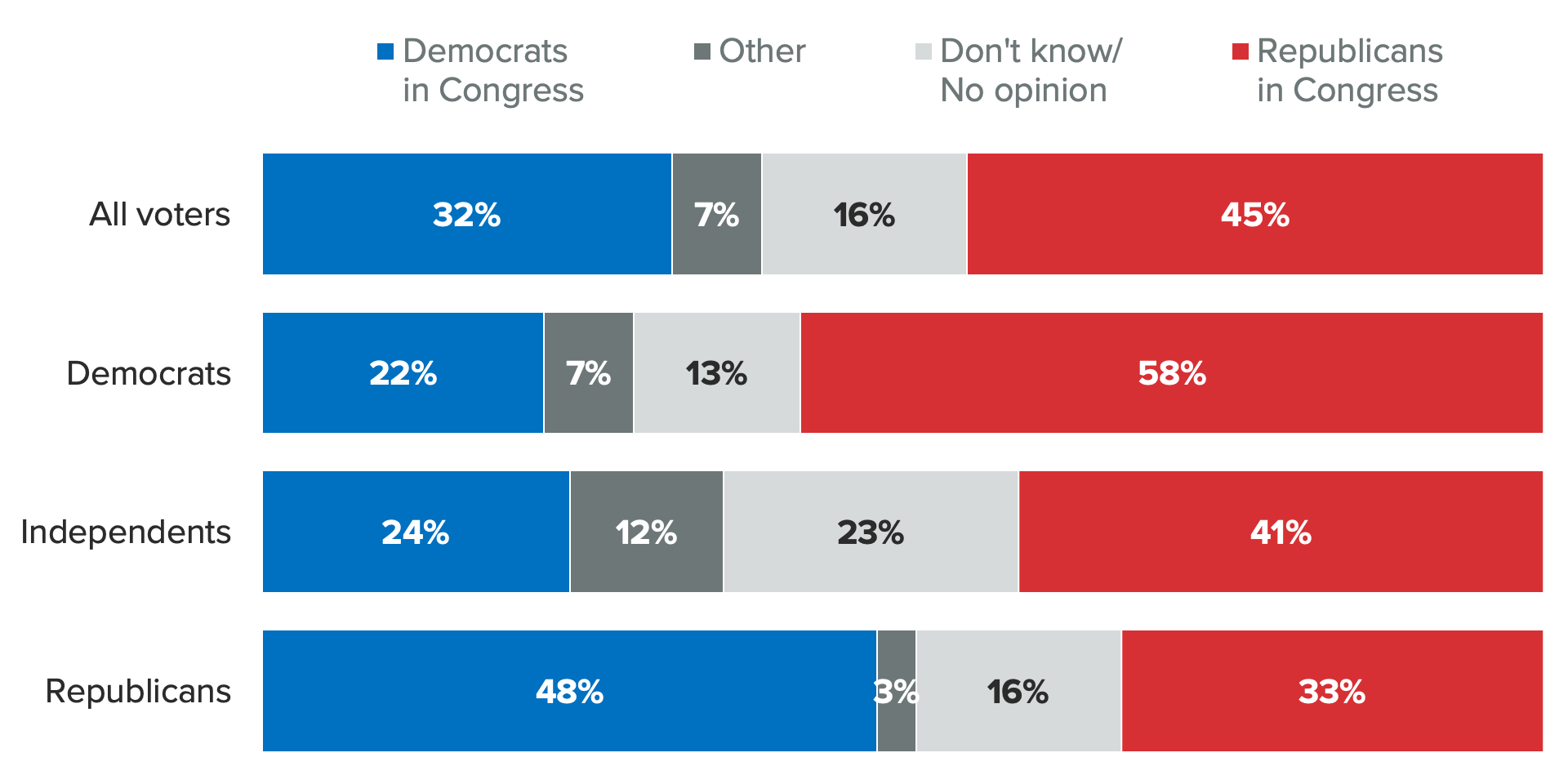
Shares of voters who said the following would be most to blame for a government shutdown: |
As we featured exclusively in yesterday’s Politico Playbook PM, 45% of voters said Republicans in Congress would be to blame if the federal government shuts down on Oct. 1 because an agreement is not reached on funding levels, compared with 32% who said they would blame congressional Democrats. Notably, Republican voters are more likely than Democrats to say their own party would be at fault (33% to 22%), while independents are more likely to point their fingers to the right than the left (41% to 24%) as voters of all partisan stripes have become more aware of the shutdown fight. While all parties take some blame for shutdowns, Republicans should understand that there is a palpable perception among voters that their majority status in Washington renders them responsible for the outcome in the outset, regardless of who is actually threatening to withhold their votes. Read more from me here. |
|
|
|